
The Temporary Timeline Hypothesis
A Journey Through the Possibility of Time Travel
This is not a claim about how time travel works. It is a record of an idea that changed as it was questioned: first many existing timelines, then timelines created by travel, then timelines that exist only for as long as the traveler is there. Each version had problems. Every problem created a better question.
- Author
- Abubaker (Alexzander)
- Type
- Speculative Hypothesis / Philosophical Exploration
- Status
- Speculative / Unverified
- Topics
- Time Travel · Spacetime · Timelines · Quantum Mechanics · Information · Reality
- Created
- 20 August 2026
- Last updated
- 20 August 2026
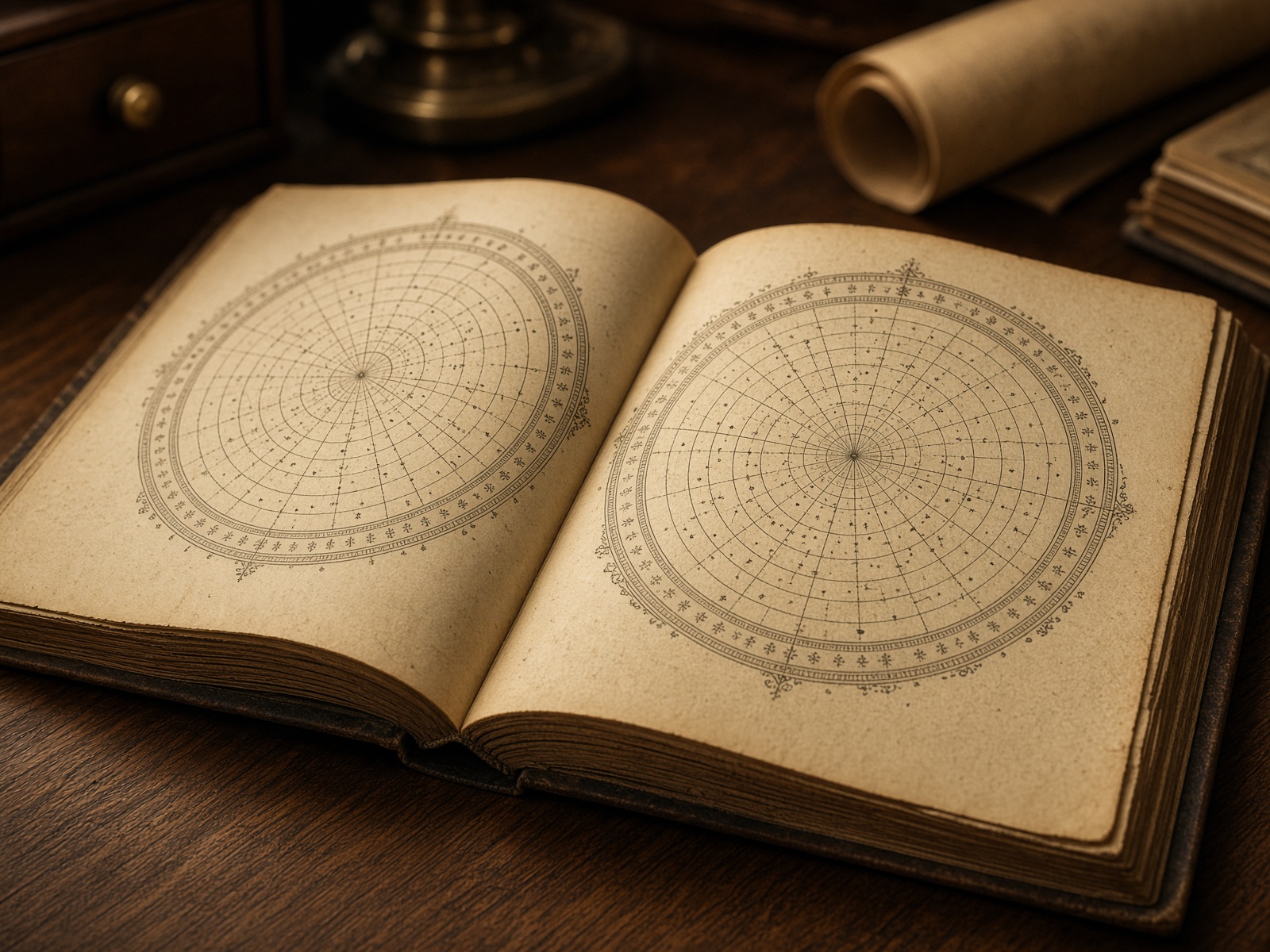
Figure 1. A chart as a metaphor for mapping possible histories. The image is illustrative, not astronomical or physical evidence.
Contents
Classification
This entry is a speculative hypothesis and philosophical exploration by Abubaker (Alexzander). Subject areas: time travel, spacetime, branching timelines, quantum mechanics, information, and reality. Standing: speculative / unverified.
A Question That Started Everything
The idea of time travel has always fascinated humanity. The thought that one day a person could move through the fourth dimension and visit the past or future seems almost impossible, yet physics has already shown us that time is not as simple as we once believed.
According to Einstein’s theory of relativity, time is connected to space, forming what we call spacetime. We do not live in a universe where time is completely separate from reality; instead, time is woven into the structure of the universe itself.
But this creates a question:
Many explanations have been suggested. One common idea is that a future time machine could only travel back to the moment it was created. If the first time machine was invented in the year 2500, then perhaps nobody could travel to a time before 2500.
At first this idea seemed reasonable. But then I asked myself: why would the invention of the machine limit reality itself?
The past already exists as part of spacetime. The year 2026 does not disappear just because a machine was not built yet.
This question made me search for another possibility.
The First Version: Multiple Timelines
My first idea was that perhaps there are many timelines.
If time travel exists, maybe the traveler does not enter their own past. Instead, they arrive in a different timeline that contains a version of the past.
This would solve one of the biggest problems in time travel: the grandfather paradox. If someone goes back and changes something important, they would not erase their own history. They would simply create or enter another branch of reality. The original timeline would continue untouched.
In this model:
- The traveler leaves Timeline A.
- They arrive in Timeline B.
- Events in Timeline B can change.
- Timeline A remains unchanged.
This would mean that even if someone from the future attended a famous time-traveler experiment, such as Stephen Hawking’s hypothetical time-traveler party, they might not appear in our timeline. They may have arrived in another branch of reality.
The Problem of Infinite Timelines
I began questioning whether infinite timelines could truly exist.
- If timelines were truly infinite, would there be any way to navigate between them?
- Would the universe need some kind of map?
- Would the traveler have to choose from an endless number of realities?
Maybe timelines are not infinite. Perhaps there are an incredibly large number of possible timelines — so large that they appear infinite to us — but they are still limited. Or perhaps timelines are not created until something causes them to exist.
This led me to a new version of my theory.
The Second Version: Time Travel Creates the Timeline
Instead of timelines already existing, perhaps time travel itself creates a new timeline.
The moment someone attempts to travel through time, reality branches. The traveler is not traveling into an already existing past. They are creating a new path through spacetime.
This solves another problem: if no one has ever visited our past, maybe it is because nobody can. A time traveler cannot land in our timeline because the act of traveling creates a new one.
But then I questioned my own idea again. If a new timeline is created, then another problem appears: where does all the energy and information come from to create an entire reality?
A new timeline would require everything:
- matter
- energy
- history
- planets
- people
- memories
This question forced me to rethink the theory again.
The Third Version: The Temporary Timeline
Maybe the timeline is not permanently created. Maybe a time-travel timeline is more like a temporary quantum event.
A timeline appears when the traveler enters it, exists while the interaction continues, and disappears when the traveler returns — like a temporary structure created by the laws of physics.
This would explain why we never see evidence of countless abandoned timelines. The timeline exists only when needed.
This led me toward the strange world of quantum mechanics. In popular discussions of quantum physics, observation and information are often said to play unusual roles. I do not treat that as a finished scientific result here. I treat it as a door into a question.
Maybe a timeline requires some connection to the entity that created it. Maybe the traveler acts as the anchor that keeps the timeline stable. When the traveler leaves, the connection disappears and the timeline collapses.
The Question of Reality
But this created an even deeper philosophical problem.
At first I thought they might be duplicates. But then I asked myself: if a person in that timeline can think, feel, remember, and experience life, what makes them less real?
From their perspective, they are real.
The Biggest Problem: Information and Energy
Eventually I reached the hardest question: where does the information go when the timeline disappears?
Physics suggests that information is deeply connected to reality itself. Even black holes created a huge debate about whether information can truly be destroyed. That debate is a real part of modern physics. It is not, by itself, evidence for temporary timelines.
So if a temporary timeline disappears, what happens to:
- the memories created there?
- the experiences of the people?
- the events that occurred?
And even before answering that, another question appears: where did the energy and information of our own universe come from?
If we ask where a temporary timeline gets its energy, we must also ask where the energy of the universe came from in the first place.
The Big Bang remains one of the greatest mysteries of science. If time itself began with the universe, then asking what happened before time may not even be a meaningful question.
So my answer becomes: we do not know. And perhaps admitting that is not a weakness. It is the beginning of understanding.
Final Thoughts
The purpose of this theory is not to claim that I have discovered how time travel works. The purpose is to explore possibilities.
A good theory should not only provide answers; it should survive questions.
My idea changed many times:
- First, I imagined many existing timelines.
- Then I considered timelines being created by time travel.
- Then I considered temporary timelines that exist only during the travel event.
Each version had problems. But every problem created a better question. And maybe this is how our understanding of the universe grows — not by pretending we know everything, but by being brave enough to say:
Because every mystery we solve reveals another mystery waiting behind it. Perhaps the universe is not hiding its secrets from us. Perhaps it is simply waiting until we are ready to ask the right questions.
Closing Reflection
Closing reflection
Perhaps the greatest mystery of time is not whether we can travel through it, but whether the universe remembers every possibility we were never meant to see. And perhaps somewhere beyond what we call reality, every unanswered question is simply a door waiting for us to become curious enough to open it.
Sources
This page refers to well-known scientific ideas — relativity, spacetime, the information debate around black holes, and the Big Bang — as background. Those ideas are not being used as proof of the hypothesis. No external papers are cited yet. If later versions attach references, they will appear here and in the archive’s Sources index.
Changelog
The three versions on this page are part of the idea’s history. If the standing of the hypothesis changes, that change should be dated.
Revision history
- 20 August 2026 — First published in this archive, including the three successive versions of the idea.
Related theories
- A Room Full of Me Paradox — A philosophical thought experiment about identity, responsibility, and the relationship between every version of ourselves throughout time.
- The Layered Evidence Model — A working method for separating established fact from observation, interpretation, hypothesis, and speculation.